
Navigate Winter Roads Safely: Auto Insurance Claims & Essential Driving Tips
As the winter season sets in, the challenges of navigating icy and unpredictable roads become a daily reality for many drivers. For financially savvy individuals who meticulously optimize every aspect of their portfolios—from tax strategies to health insurance renewal—winter driving presents a unique set of risks that must be managed. Safeguarding your journeys on treacherous roads is not merely a matter of physical safety; it is a critical component of comprehensive asset protection. A single lapse in preparation can lead to catastrophic physical damage and severe financial strain.
I have witnessed firsthand how rapidly a routine winter commute can escalate into a complex liability nightmare. The financial implications of a winter collision extend far beyond the immediate repair costs, potentially impacting your long-term insurance premiums and exposing you to third-party litigation. Therefore, proactive risk management is absolutely essential for preserving your wealth during the colder months.
This comprehensive guide serves as your authoritative handbook for mitigating vehicular risks. We will explore advanced preventive maintenance measures alongside a deep technical dive into how your auto insurance policy operates as your primary financial safety net. By mastering slippery road techniques and understanding the precise claims protocols, you can ensure your winter travels remain as secure as your broader financial strategy.
1. The Financial Reality of Winter’s Treacherous Embrace
Winter introduces a unique array of hazardous variables, including black ice, severely reduced visibility, and unpredictable localized blizzards. The enchanting aesthetics of a fresh snowfall quickly fade when confronted with the statistical reality of increased collision rates. Acknowledging these elevated risks is the foundational step in effective seasonal risk mitigation.
During the winter months, auto insurance claims spike dramatically as breakdown frequencies multiply. The financial fallout from even a minor fender bender on a slick road can quickly erode your emergency savings if you are improperly insured. For responsible planners, adopting a dual focus on rigorous prevention and ironclad insurance protection is the only viable strategy.
Understanding this dual approach is critical for navigating your year-end financial commitments. The principles of winter driving remain constant, but the economic landscape necessitates an updated review of your coverage. Integrating this knowledge with your broader comprehensive holiday guide and seasonal safety plan ensures optimal protection.
2. Pre-Trip Asset Audits: Preparing Your Vehicle for Winter
You would never execute a major financial investment without rigorous due diligence, and you should never tackle winter roads without thoroughly preparing your vehicle. A well-maintained vehicle drastically reduces the probability of mechanical failures, thereby preventing exorbitant emergency towing fees and potential accidents. Treat your winter vehicle preparation as a strict, localized financial audit.
Every mechanical component must be evaluated and optimized for sub-zero performance. This proactive capital expenditure protects your much larger asset—the vehicle itself—from catastrophic depreciation. Let us outline the mandatory pre-trip maintenance protocols you must implement.
Tire Infrastructure: The Foundation of Grip
Your tires are the sole point of contact between your multi-ton vehicle and the asphalt, making them the most critical safety component. Neglecting tire maintenance in winter is akin to building a financial portfolio on volatile, untested assets. Investing in premium winter tires is a highly strategic preemptive measure that dramatically reduces the risk of skids and subsequent insurance claims.
- Winter Compound Superiority: Dedicated winter tires feature softer rubber compounds and aggressive tread designs that maintain maximum grip when ambient temperatures drop below 45°F (7°C).
- Tread Depth and PSI: Tire tread must not fall below 4/32nds of an inch. Furthermore, cold weather naturally deflates tires; continually verify that your pressure matches the manufacturer’s recommended PSI.
Battery Resilience and Essential Fluids
Sub-zero temperatures aggressively degrade battery efficiency, exposing underlying weaknesses that remain hidden during the summer. A dead battery results in immediate immobilization, requiring costly roadside interventions. Similarly, improper fluid viscosity can lead to catastrophic engine block failures.
- Diagnostic Testing: Have a certified mechanic conduct a load test on your battery. Proactively replace any unit approaching three to five years of age to prevent sudden failures.
- Coolant and Oil Viscosity: Verify your antifreeze ratio is optimized (typically a 50/50 blend) to prevent the engine core from freezing. Utilize the correct, thinner winter-grade motor oil (such as 0W or 5W) to ensure rapid lubrication during cold starts.
- Winter Wiper Fluid: Swap standard windshield fluid for a winter-specific formula that resists freezing upon contact with frigid glass, ensuring uninterrupted visibility.
Visibility and Braking Efficacy
Winter conditions drastically reduce visibility and significantly extend required stopping distances. Functional exterior lighting ensures you remain visible to surrounding traffic during whiteout conditions. Simultaneously, your braking system must be in peak condition to prevent high-velocity impacts.
- Illumination and Wipers: Replace streaking wiper blades with heavy-duty winter variants. Audit all exterior bulbs—headlights, taillights, and hazards—to ensure maximum photon output.
- Rotor and Pad Inspection: Have a professional assess your brake pads and rotors for excessive wear. Maximum stopping power is non-negotiable when tire traction is fundamentally compromised by ice.
The Roadside Lifeline: Your Emergency Kit
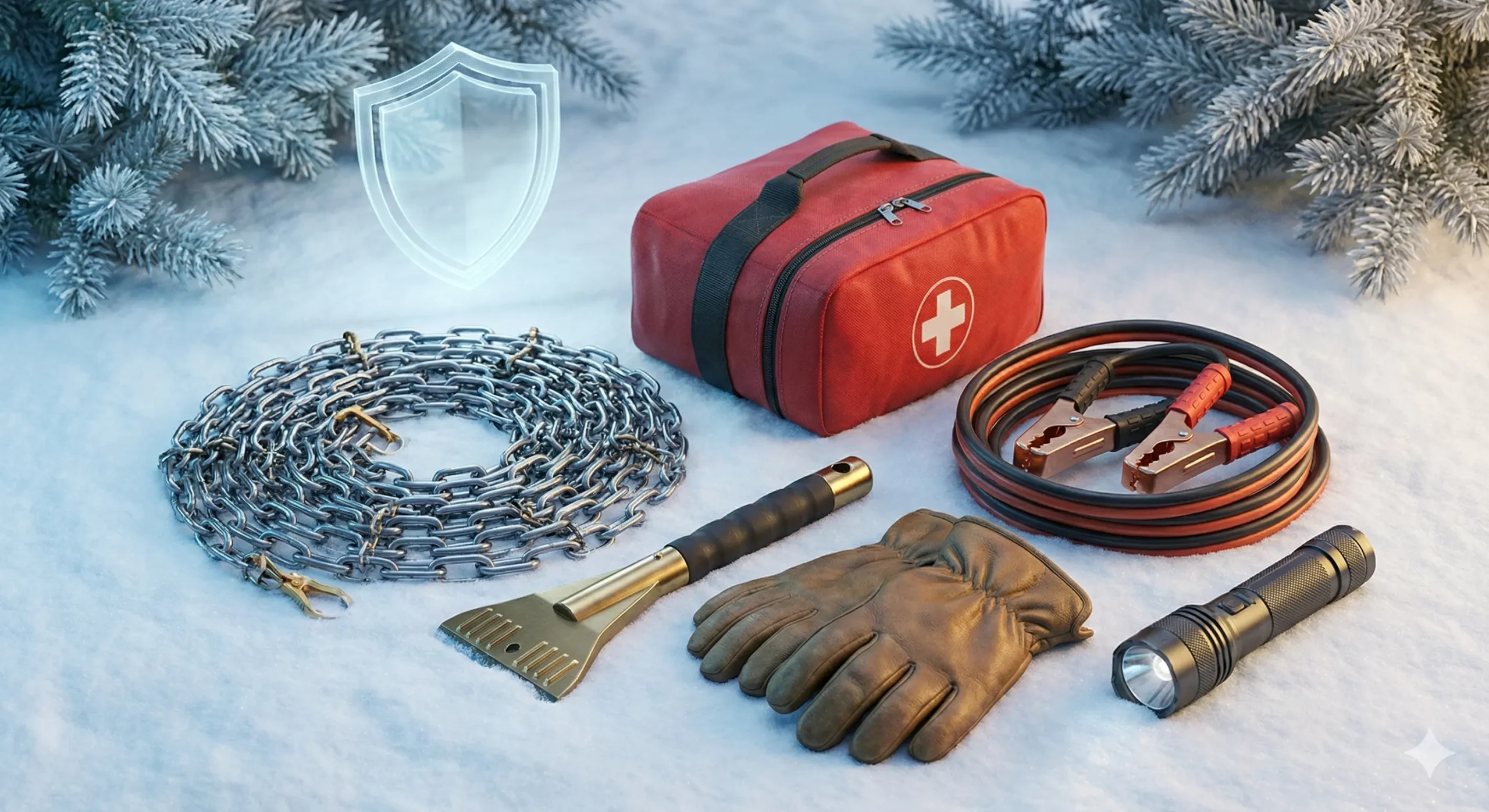
Even with pristine maintenance, the sheer unpredictability of winter weather means immobilization remains a statistical possibility. A fully stocked winter emergency kit acts as an invaluable, physical insurance policy. It transforms a potentially lethal stranding scenario into a mere logistical inconvenience.
- Essential Provisions: Your trunk must contain heavy-duty jumper cables, thermal blankets, a comprehensive first-aid kit, a compact snow shovel, and an abrasive material like cat litter for emergency traction.
- Sustenance and Communication: Pack high-calorie non-perishable foods, bottled water, high-lumen flashlights, and a dedicated portable battery bank to keep your mobile phone active.
3. Mastering Winter Dynamics: Advanced Driving Techniques
Physical vehicle preparation represents only fifty percent of your risk management strategy. The remaining fifty percent relies entirely on adapting your driving methodology to the compromised physics of winter roads. Aggressive inputs rapidly break traction, leading to uncontrolled multi-ton projectiles.
Patience and deliberate, gentle mechanical inputs are your greatest assets. The conventional rules of the road must be drastically adjusted when friction coefficients plummet. Let us explore the critical techniques for maintaining absolute vehicular control.
Velocity Reduction and Spatial Awareness
Kinetic energy is the primary enemy of winter driving. The faster your vehicle travels, the exponentially longer it requires to bleed off that speed on ice. Standard following distances are entirely insufficient when roads are slick.
You must double or even triple your traditional following distance behind other motorists. This buffers your reaction time, allowing you to respond smoothly to sudden hazards rather than engaging in panic braking. Maintaining a massive spatial buffer is essentially free liability insurance.
Finesse Operations: Braking and Accelerating
Sudden mechanical inputs instantly initiate terrifying vehicular skids. You must operate the accelerator and brake pedals with extreme finesse, acting as though you are driving on fragile glass. This smooth operation also mitigates excessive mechanical wear on your transmission and drivetrain.
- Linear Inputs: Accelerate with gradual, linear pressure to prevent immediate wheel spin. When braking, apply a steady, consistent force to avoid locking the calipers.
- Leveraging ABS: If your Anti-lock Braking System (ABS) engages, you will feel a violent pulsation in the pedal. Maintain firm pressure; the ABS system rapidly pulses the brakes to allow you to maintain steering input, though it does not defy physics to magically shorten your stopping distance on pure ice.
Mitigating Invisible Threats: Black Ice and Skids
Black ice is a nearly invisible, transparent layer of frozen moisture that blends perfectly with the asphalt. Striking black ice instantly drops your traction to zero, making it a leading catalyst for multi-vehicle pileups. If your vehicle begins to skid, absolute composure is required to regain control.
- Recognizing Black Ice: Assume black ice is present on elevated bridges, overpasses, and permanently shaded roadways. If the asphalt appears wet and glossy but the ambient temperature is below freezing, you are likely looking at black ice.
- Executing Skid Recovery: If your rear tires lose traction (oversteer), steer gently into the direction of the skid. Never panic-brake or jerk the steering wheel aggressively, as extreme overcorrection guarantees a secondary, more violent spin.
Proactive Route Logistics
A disciplined investor heavily researches market conditions before deploying capital, and a safe driver audits local meteorology before turning the ignition. Proactive route planning allows you to bypass high-risk zones or delay your travel entirely during severe weather warnings.
Always review real-time traffic data and Doppler radar before departing. If conditions deteriorate rapidly, postponing your journey is the ultimate risk mitigation strategy, especially if you have secured robust trip cancellation coverage.
4. Post-Collision Protocols: Immediate Risk Mitigation
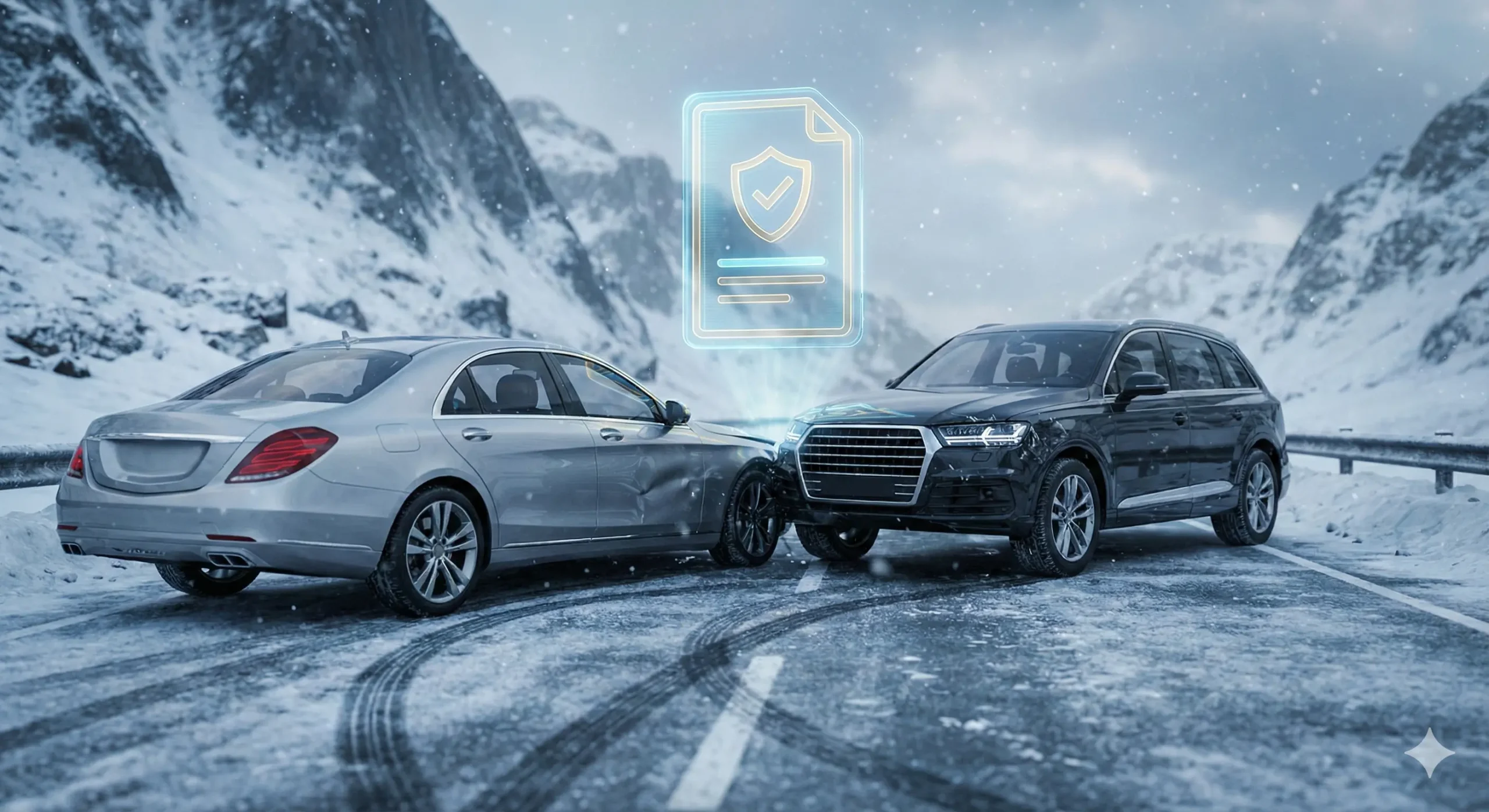
Despite executing flawless defensive driving, the actions of other motorists or sudden environmental shifts can still result in a collision. The immediate minutes following an impact are critical for securing physical safety and preserving the integrity of your impending insurance claim. Panic naturally sets in, but you must implement a structured, methodical response protocol.
Understanding these logistical complexities serves as an immense defensive advantage. Adhering to a strict post-accident checklist guarantees vital evidence is secured before the scene is cleared. Let us define the exact operational steps required following a crash.
Securing the Environment and Involving Authorities
Your paramount objective is the immediate physical safety of all vehicle occupants. A winter accident scene is highly volatile, featuring the risk of secondary collisions from approaching vehicles unable to stop on the ice.
- Immediate Evacuation: If the vehicle is operational, carefully pilot it to the shoulder to clear the active traffic lanes, and activate your hazard strobes. If the vehicle is immobilized in a high-traffic lane, remain securely buckled inside unless there is an active fire threat.
- Summoning Responders: Immediately dial emergency services to request police and medical personnel if injuries are present. Securing an official police report is often a mandatory requirement for insurers to process liability claims effectively.
Aggressive Evidence Collection
Once safety is verified, you must transition into an evidence-gathering mindset. The precision and volume of the data you collect directly influence the speed and success of your financial settlement. Relying purely on memory during a high-adrenaline event is a massive liability.
- Data Acquisition: Obtain the legal names, contact numbers, driver’s license details, and exact insurance policy numbers of all involved motorists. Secure contact details from any independent witnesses, as their objective testimony is invaluable during liability disputes.
- Visual Documentation: Utilize your smartphone to photograph the vehicles from multiple angles, capturing the points of impact, deployed airbags, and surrounding road conditions.
- Silence on Liability: Never apologize or admit fault at the scene, as these statements can be legally weaponized by opposing insurance adjusters. Allow the police and forensic claims teams to determine official liability.
5. Navigating the Bureaucracy of Auto Claims
Initiating an auto insurance claim initiates a complex financial negotiation with your underwriter. Understanding the mechanics of this bureaucracy is just as critical as your defensive driving skills. It involves intimately knowing your contractual rights and communicating aggressively to secure your authorized indemnification.
This process relies heavily on the data you collected at the crash site. By maintaining an organized and professional dialogue with the assigned personnel, you can expedite the release of funds. Here is the roadmap for navigating the standard claims architecture.
Initiation and Deductible Mechanics
Promptly reporting the incident to your carrier’s 24/7 claims department is a strict contractual obligation. Delaying this notification can result in severe processing delays or outright claim denials. You must possess a firm understanding of your out-of-pocket financial responsibilities before the payout is triggered.
- The Deductible Hurdle: Your deductible is the fixed capital amount you must surrender before the insurer covers the remaining balance. For instance, if you incur $4,000 in damages and hold a $1,000 deductible, you must pay the initial $1,000 out of pocket.
- Adjuster Deployment: The insurer will assign a claims adjuster to formally investigate the collision dynamics and calculate the exact repair valuation. Presenting your meticulously gathered photographic evidence streamlines their assessment.
Repair Authorization vs. Total Loss Declarations
The adjuster holds the authority to decide if the vehicle will be repaired or financially written off as a total loss. This determination hinges on complex mathematical thresholds governed by state regulations and carrier policies.
- Total Loss Thresholds: If the projected repair costs—combined with the vehicle’s salvage value—exceed a specific percentage of its Actual Cash Value (ACV) (often between 70% and 80%), the vehicle is deemed totaled.
- ACV Settlements: In a total loss scenario, the insurer issues a settlement check equating to the vehicle’s pre-crash ACV, strictly minus your deductible. You maintain the right to negotiate this ACV if you can present comparable market data proving a higher valuation.
6. Deep Dive: Decoding Your Auto Insurance Policy
Insurance is a vital instrument for hedging against catastrophic wealth destruction. During the treacherous winter season, intimately understanding the specific coverages within your auto policy is absolutely paramount. Knowing how specific clauses trigger during varied cold-weather perils prevents devastating out-of-pocket expenses.
We strongly advise executing an annual policy audit to verify your coverage limits remain aligned with your current net worth and risk exposure. This audit is a core element of any sophisticated holiday insurance overview. Let us decode the primary coverage blocks that shield your capital.
Collision and Comprehensive: The Twin Pillars of Protection
Collision coverage is designed exclusively to repair or replace your vehicle following a kinetic impact, regardless of fault. Whether you slide into a retaining wall on black ice or strike another vehicle, this coverage indemnifies your asset, making it indispensable for modern winter driving.
Comprehensive coverage acts as your shield against environmental and non-kinetic threats. This specialized tier covers damages resulting from heavy snow loads collapsing onto the roof, falling ice branches, or impacts with winter wildlife wandering onto dark roadways. Comprehensive essentially covers everything outside of standard vehicle-to-vehicle collisions.
Liability and Uninsured Motorist Shielding
Liability coverage is a legal mandate that shields your personal wealth from predatory third-party lawsuits. If you are deemed at fault for a winter collision, Bodily Injury (BI) and Property Damage (PD) liability cover the medical bills and asset repairs of the opposing party. Carrying high liability limits is critical to preventing wage garnishments or asset seizure following a severe crash.
Simultaneously, Uninsured/Underinsured Motorist (UM/UIM) coverage is a vital defensive layer. It protects your physical and financial health if you are struck by a reckless driver who lacks the requisite insurance capital to pay for your damages or attempts to flee the scene entirely.
Logistical Riders: Roadside and Rental Reimbursement
Being stranded in a disabled vehicle during sub-zero temperatures elevates a mechanical failure into a life-threatening emergency. Roadside assistance riders cover the exorbitant costs of emergency towing, battery jump-starts, and lockout services.
Furthermore, if your vehicle requires extensive time in the collision center, Rental Car Reimbursement coverage funds your temporary transportation. This rider prevents severe disruptions to your daily operations and shields you from incurring thousands of dollars in out-of-pocket rental agency fees.
7. Conclusion: Drive Smart and Preserve Your Wealth
Coupling these operational skills with a deep, technical understanding of your auto insurance policy guarantees that your wealth remains insulated from sudden disaster. Do not wait until the snow is falling to review your declaration pages. Contact your broker today to verify your limits are robust enough to withstand the financial impacts of winter travel.
Frequently Asked Questions (FAQ)
What is the main difference between collision and comprehensive coverage for winter accidents?
Collision coverage specifically indemnifies damages sustained from your vehicle physically impacting another vehicle or a stationary object, such as skidding into a guardrail on an icy road. Comprehensive coverage, conversely, protects your asset against non-collision environmental perils that are highly prevalent in winter. This includes damage from falling tree branches weighed down by ice, massive hail, vandalism, or striking an animal that has wandered onto the road.
Will my auto insurance rates automatically increase after a winter accident claim?
Not inherently. The impact on your future premium calculations relies on several complex underwriting factors, primarily the official determination of fault. A “not-at-fault” collision claim generally has a minimal impact on your rates compared to an “at-fault” determination. Additionally, your historical driving record, the total payout severity of the accident, and your specific carrier’s internal surcharge schedules all play a critical role in rate adjustments.
How does auto insurance cover accidents involving black ice?
If you lose traction on black ice and subsequently strike another vehicle, a building, or a light pole, your collision coverage will activate to cover the repairs to your vehicle, minus your required deductible. However, if the black ice causes a purely non-collision event—such as sliding smoothly into a deep snowbank ditch without impacting any physical structures—the damage might be processed under your comprehensive coverage, depending on the exact wording and exclusions of your specific policy.